 Dossier

Gvantsa Lomadze
Corporate Lawyer
According to her LinkedIn profile, Gvantsa Lomadze is the corporate lawyer of the Next Group. She is the person who has stated Next's legal position, twice: by WhatsApp in February 2026 and by email in July. Between them she gave six grounds for my obligation to sign a management agreement and a common-area service agreement, neither of which I signed. Her conduct is examined along with Saba Tsiskaradze's against Article 150 of the Criminal Code of Georgia.
February
On February 4, 2026, a week after Saba Tsiskaradze sent the two contract drafts, I wrote to her proposing a plain service agreement, with a prescribed set of services at a prescribed price.
Her reply said that “under the Transfer Agreement concluded between you and the previous owner”, all his obligations towards Next had passed to me; that I had bought “in a hotel-type complex”, which is why the agreements “is required”; that Next is “required by applicable regulations to have such agreements in place with all unit owners”; that the documents were “standard”, “previously agreed and signed by all owners”, and did not limit my ownership rights.
I answered that, as far as I recalled, the only document I had signed with him was the standard transfer at City Hall, and asked for a copy of the one she meant, signed by me. She did not have it: it “should have signed between the two of you”.
Then, “regardless of the form of the transfer agreement, by acquiring the apartment in the NEXT White multifunctional complex, you obtained ownership in a property that forms part of a multifunctional complex” and, accordingly, “the conclusion of management and service agreements with the complex operator is a mandatory condition applicable to all unit owners”. That message was edited; I do not believe I saw the original.
Asked what Next owed me for its own transgressions, she directed me to email, where my request “will be reviewed with the Chief Legal Officer”. I sent it that morning. It has never been reviewed.
The next day I proposed paying for the services already billed against a receipt; she asked me to measure the apartment, I sent the titles and the measurements, and in March I paid GEL 2,170, with no contract, out of good faith and expecting the review that never came. The chat ends there.
July
Her reply of July 7 to my request for documents, relayed by Saba, rests on a different agreement: no longer mine with the previous owner but “the Preliminary Sale and Purchase Agreement executed between the buyers and the Developer”, under which “every purchaser undertook the obligation to execute the Management Agreement and the Common-Area Service Agreement upon registration of ownership”. That is the sentence that explains the date on the management agreement.
Copies of the previous owner's agreements she declined as “confidential contractual documents”. Asked to identify any registered encumbrance, she confirmed that none is registered against either title.
Asked for the legal provision that requires an owner to sign, she named none: the obligation is “directly connected with the operational model of the NEXT White multifunctional residential complex” and with “obligations undertaken by the Developer” before the authorities for “the management and operation of the complex as a touristic enterprise”, the one time anyone at Next has used the correct term for a status that binds the developer.
Fees, she wrote, run from the date services were “factually commenced”, independently of the building's commissioning, which has not happened; among the services listed is “operation of elevators through card access”. The gas documentation she left to after-sales.
Since
My three insistences on the gas documents were addressed to her, and every letter from the demand of August 11 onward was copied to her. She has not written since July 7.
Training on Human Rights
A year ago, before these events, on a post on her LinkedIn profile, she stated:
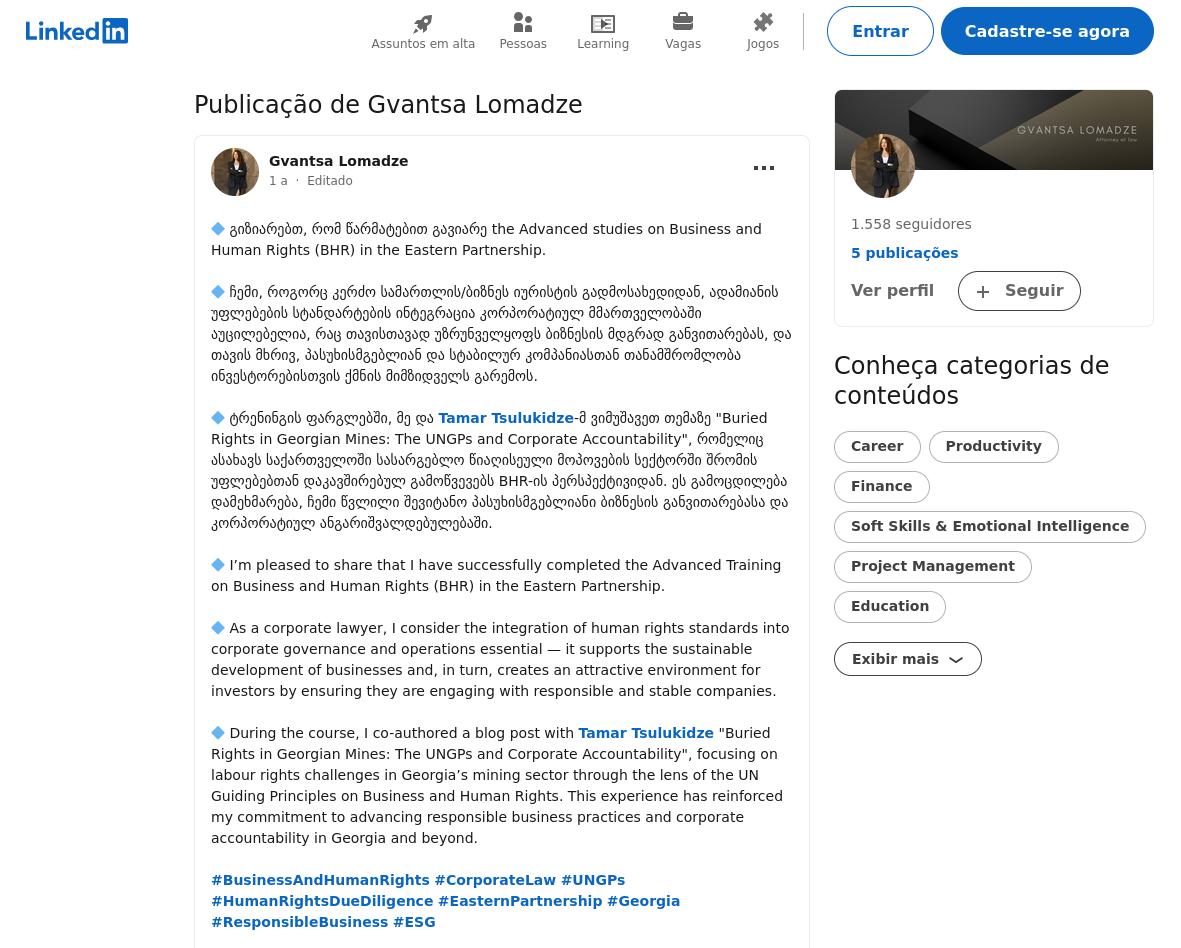
“I’m pleased to share that I have successfully completed the Advanced Training on Business and Human Rights (BHR) in the Eastern Partnership.
As a corporate lawyer, I consider the integration of human rights standards into corporate governance and operations essential — it supports the sustainable development of businesses and, in turn, creates an attractive environment for investors by ensuring they are engaging with responsible and stable companies.”
I just have to say that at times this dossier writes itself.
She also mentioned that she “co-authored a blog post with Tamar Tsulukidze”, “through the lens of the UN Guiding Principles on Business and Human Rights”.
Let me just recollect two of these principles:
- In all contexts, business enterprises should:
(a) Comply with all applicable laws and respect internationally recognized human rights, wherever they operate;
- To make it possible for grievances to be addressed early and remediated directly, business enterprises should establish or participate in effective operational-level grievance mechanisms for individuals and communities who may be adversely impacted.
g.lomadze@nextgroup.ge- gvantsa-lomadze-0963b3169